エピソード

  • Leadership is bringing people along... through empathy, integrity, and curiosity | Mary Anne Chambers
    2026/04/29
    And meeting them where they're at.

    In this episode of Messy, Daniel Atlin sits down with Mary Anne Chambers, former Ontario cabinet minister, banking executive, and lifelong advocate for equity and access, to explore what it truly means to lead in complex, purpose and people-centered systems.

    From her early experiences growing up in Jamaica, where she learned to understand lives different from her own, to her work as a bank executive, to a member of government and minister shaping policies that expanded access to education and childcare, Mary Anne reflects on the power of empathy, integrity, and lived experience in leadership.

    This conversation goes beyond titles and achievements. It’s about how leaders navigate competing pressures, balance politics with purpose, and make decisions that serve the public good, even when those decisions are difficult.

    At its core, this episode is a reminder that leadership in the mess isn’t about control or authority. It’s an inspiring and motivating conversation about connection and meeting people where they are, listening deeply, and bringing others along toward a shared future.

    Key Takeaways:
    • Empathy is not soft, rather it’s essential for effective leadership
    • People’s decisions make sense only when you understand their context
    • Structural barriers often hide opportunity and talent
    • Leadership is about influence, not just authority
    • Good public policy requires long-term thinking not quick fixes
    • Trust and integrity are a leader’s most valuable capital
    • Listening does not mean agreeing, it means understanding
    • Leadership is about bringing people along, not pushing them forward.

    I hope you'll find this conversation helpful and motivating in getting through the mess. If you like it, please write a review and share it with a friend.

    Working through messes is easier with others. Mary Anne Chambers' profile as Chancellor at the University of Guelph · Website · Connect with Daniel on LinkedIn
    続きを読む 一部表示
    56 分
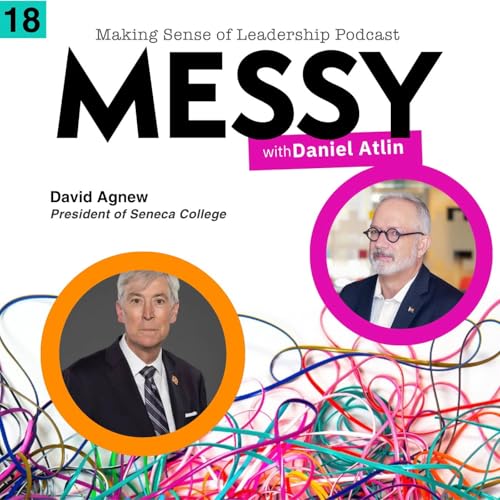
  • What others see as messes, some see opportunities | David Agnew
    2026/04/15
    Don't be afraid to try something new.

    What does it take to lead in systems that are complex, constrained, and constantly changing?

    Daniel Atlin sits down with David Agnew, President of Seneca Polytechnic, whose career has spanned politics, finance, international development, and higher education. One common is stepping into organisations at moments of tension, transition, and uncertainty.

    This conversation explores what leadership really looks like in public institutions, where the stakes are high, the problems are rarely neat, and the pressure to act is constant. It’s about navigating competing demands, making decisions you know will be unpopular, and holding steady in the storm.

    Key insights:
    1. Leadership is holding tension, not resolving it. Organisations want stability but reality demands change.
    2. Not all “mess” is the same. It can be a transition, a leadership gap, or a system under pressure
    3. Public institutions operate under different rules. Unlike businesses, they don’t choose their customers and can’t walk away from problems
    4. Leadership is not a popularity contest. Leaders must make decisions without full agreement, withstand criticism, and accept not everyone will be satisfied
    5. Inner sensemaking shapes outer action. Before decisions there is a process happening internally: What matters? What do I stand for? What am I willing to act on?
    6. Time horizons matter. In many public systems today's decisions may not yield results for years. Leaders must think long-term but act in the present, and manage expectations in between
    7. Careers and leadership journeys are rarely linear. Plans change, opportunities emerge, and growth often comes from stepping into the unknown

    This episode is a reminder that leadership in messy systems isn’t about having the answers. What some people see as a mess, others see as meaningful work. Connect with David Agnew on LinkedIn · Seneca Polytechnic Website · Website · Connect with Daniel on LinkedIn
    続きを読む 一部表示
    59 分
  • Putting the Mouth Back into the Body Politic | Sara Hurley
    2026/03/25
    Public Service = Designing Fairness at Scale.

    In this episode of Messy, Daniel Atlin is joined by Sara Hurley, former Chief Dental Officer for England, a leader whose career spans frontline clinical care, military service, and senior government leadership. Few have operated as consistently at the intersection of individual care, institutional complexity, and public policy.

    Sara offers a deeply reflective account of leadership in the mess.
    Drawing on her experience during COVID, she describes what it feels like to make decisions when there are no good options — only trade-offs. In these moments, she argues, leadership is not about projecting certainty, but about holding uncertainty on behalf of others, while maintaining trust, clarity, and integrity.

    The conversation moves fluidly between the personal and the systemic:
    • The shift from authority to trust as the foundation of leadership
    • The emotional labour of carrying responsibility in complex systems
    • The challenge of leading in environments where outcomes are delayed, diffuse, and often invisible
    • The importance of stewardship — leaving systems better than you found them, even if the impact unfolds long after you’ve left

    Sara also makes a compelling case for public service as one of the last places where fairness can be intentionally designed into systems at scale — an idea that feels increasingly urgent in a time of institutional mistrust.

    At its core, this episode is about sensemaking: how leaders navigate ambiguity internally, while shaping systems externally.

    It’s a conversation about leadership in the real world: messy, human, and deeply consequential.

    If you like this episode please write a review and share it with a friend. Sara Hurley's LinkedIn · Website · Connect with Daniel on LinkedIn
    続きを読む 一部表示
    56 分
  • Is the University Model Broken? | Tim Blackman
    2026/03/11
    Rethinking higher education — and finding your purpose.

    What if the real problem with higher education isn’t funding, technology, or rankings, but the model itself?

    In this episode, Daniel Atlin speaks with Tim Blackman, former Vice-Chancellor and President of the Open University, about whether the dominant university model is simply out of sync with modern life.

    While most universities still organise learning around a single intensive period in early adulthood, Tim argues that the future lies in lifelong learning, shorter credentials, and education woven throughout people’s working lives. Drawing on his experience leading one of the largest and most distinctive universities in the UK, he reflects on the challenge of changing institutions that are structurally designed to protect the status quo.

    But this conversation is also deeply personal.

    While in his role leading the Open University, Tim was diagnosed with stage four prostate cancer. The experience forced a profound pause, prompting him to reflect on legacy, responsibility, and a simple but powerful question: What kind of world do I want to leave my grandchildren?

    That moment sharpened his focus on the larger purpose of higher education. In his recent paper for the Higher Education Policy Institute, Tim argues that universities should orient themselves around a guiding mission: helping to build a sustainable economy: environmentally, socially, and financially.

    The discussion ranges from institutional leadership and lifelong learning to the challenge of misinformation in an increasingly fragmented knowledge landscape.

    Above all, it’s a conversation about purpose and the reminder that it is never too late to rethink your work, your impact, and the difference you want to make. In a messy world, Tim reminds us that leadership isn’t just about managing institutions - it’s about deciding what really matters with the time we have. Connect with Tim on LinkedIn · The HEPI paper · Website · Connect with Daniel on LinkedIn
    続きを読む 一部表示
    51 分
  • Making Sense of Making Sense | Why the mess matters
    2026/03/04
    This episode is different.

    There’s no guest. It’s just me, Daniel Atlin, answering the question I ask every leader who comes on Messy: to riff off the Kierkegaard quote “Life must be lived forwards, but can only be understood backwards."

    I look back at the moments that shaped my curiosity about leadership, complexity, and what I now call “the mess.” I talk about growing up between cultures and religions, about realising I was gay in the 1980s, about feeling different and discovering that everyone carries a backstory you can’t see.

    After senior roles across government, cooperative organisations, and higher education, I kept noticing the same pattern: smart people, important missions, and good intentions. And… stalled initiatives, quiet failures, and exhausted leaders.

    Why is leadership in mission-driven organisations so difficult?

    That question led me to study leadership more formally at Oxford and HEC Paris and to interview 25 university leader across four countries. What I discovered surprised me.

    Leaders who navigated complexity most effectively weren’t the ones with perfect strategies but the ones who could make sense of politics, competing narratives, incomplete data, and their own emotional reactions.
    They were practicing two forms of sensemaking at the same time:
    1. Personal sensemaking: regulating emotion, building resilience, understanding how your nervous system affects the organisation.
    2. Organisational sensemaking: exploring the terrain, shaping narrative, improvising when plans collide with reality, and adapting collaboratively.
    When those two disconnect, leadership falters.

    When they align, something powerful happens.

    This episode explains what I’ve learned so far, and why naming complexity is oddly liberating.

    If you’re wrestling with leadership in uncertain times, this episode and the series is for you. Website · Connect with Daniel on LinkedIn
    続きを読む 一部表示
    9 分
  • Should you Collaborate with the Enemy? | Adam Kahane
    2026/02/25
    If you're not part of the problem, you can't be part of the solution.

    In this episode of Messy, Daniel Atlin sits down with global facilitator and systems practitioner Adam Kahane to explore what it really means to collaborate when agreement feels impossible.

    They explore collaboration across deep divides, the courage to see our own part in the problem, and how change often starts in the smallest crack in a hardened system.

    Drawing from his newly revised second edition of "Collaborating with the Enemy", Adam challenges the romantic idea that collaboration is always the right answer. Instead, he offers a more grounded framework: collaboration is one option among four, alongside forcing, adapting, and exiting. The key question is “When, and under what conditions, is collaboration the most viable path?”

    The conversation explores several core ideas:
    • "Enemy-fying": Adam’s invented word for the habit of labeling others as enemies simply because we disagree with them. In polarized systems, this reflex deepens fragmentation and limits our options.

    • The Three Stretches of Collaboration:
    1. Embrace conflict as well as connection
    2. Experiment your way forward
    3. Recognise your role in the game

    • Power, Love, and Justice: Drawing on Martin Luther King Jr. and Paul Tillich, Adam frames social change as a tension between the drive to realize oneself (power), the drive to unify the separated (love), and the structures that balance the two (justice).

    • Failure as Teacher: Adam speaks candidly about mistakes in both professional and personal contexts, arguing that experimentation, not certainty, is the only way forward in complex systems.

    One of the key take aways for those interested in “Messy” leadership is that collaboration begins not with technique, but with introspection: Who am I in this system? How am I contributing to the very dynamics I’m frustrated by?

    If you like this episode, share it with a friend. And buy Adam's book! Link to Adam's book: Collaborating with the Enemy · Reos Partners Website · Website · Connect with Daniel on LinkedIn
    続きを読む 一部表示
    51 分
  • Between the Dance Floor and the Balcony | Iain Martin
    2026/02/10
    Leading across Australia, the UK, and New Zealand.

    What does it mean to lead a university when trust in public institutions is eroding and the rules keep changing?

    In this episode of Messy, I speak with Iain Martin, President and Vice-Chancellor of Deakin University, about navigating leadership in the thick of complexity. From global rankings and political scrutiny to AI, massification, and polarisation, the conversation surfaces the often unseen pressures shaping modern universities.

    The “dance floor and balcony” metaphor comes from the adaptive leadership work of Ron Heifetz and Marty Linsky. It captures the leadership challenge of staying grounded in day-to-day realities while also stepping back to see system-level patterns.

    Iain reflects on his leadership journey across three Commonwealth systems. He shares how curiosity, narrative, and sensemaking (rather than rigid planning) have guided his approach. Central to the discussion is the idea of social license: who grants it, how easily it can be lost, and why rebuilding it requires leaders to think beyond their own institutions.

    Without offering simple solutions, this episode sits with the mess, exploring how leaders balance the dance floor and the balcony, strategy and stewardship, optimism and realism. It underscores why universities still matter as places for difficult conversations in a fractured world.

    Key highlights
    • Why universities cannot “go it alone” on social license
    • The leadership cost of ignoring community expectations
    • Universities as complex adaptive systems that require “productive chaos”
    • Transparency as a practical trust-building strategy
    • The future of assessment and learning in an AI-enabled world
    • Why narrative and storytelling are essential leadership tools

    I hope you enjoy this conversation. If you do, please write a review and share it with a friend.

    Living and leading in the mess is easier with others. Iain Martin's Bio and contact info at Deakin · Iain's discussion & paper on the social license challenge of universities · Website · Connect with Daniel on LinkedIn
    続きを読む 一部表示
    57 分
  • Structured Chaos in a Messy System | John Yip
    2026/01/28
    A little playbook, a little Picasso.

    Healthcare is often treated as a hospital story, until you need care at home.

    In this episode of Messy, I am joined by John Yip, President & CEO of SE Health, to talk about leading at the intersection of health systems, digital transformation, workforce innovation, and social purpose.

    John shares how his early work in the digital economy still echoes today, why home and community care is both essential and misunderstood, and what it takes to build alignment across a complex, distributed organisation operating in Canada’s fragmented provincial landscape. The conversation goes deep on COVID-era leadership: uncertainty, moral pressure, scarcity, and the real-world improvisation required when there is no playbook.

    We also explore what “digital transformation” should mean now and how to ensure technology serves care (not the other way around), why safe experimentation matters, and the potential of healthcare data to improve aging and wellbeing. John offers a powerful metaphor from his personal endurance project: “running every street” as a practice of curiosity, resilience, and rewiring your perspective.

    Key themes:
    • Sensemaking across long arcs of change
    • Healthcare as a complex, fragmented ecosystem
    • Leadership in distributed, mission-driven systems
    • Frontline intimacy and relational care
    • Crisis leadership requires improvisation
    • Resilience through exploration and “structured chaos”

    If leadership sometimes feels like chopping wood, this episode is a reminder: the grind is part of the work and purpose is what helps you stay even-keeled through the mess.

    If you like this episode, write a review and share. Leading through the mess is easier with friends and colleagues. SE Health Website · Running magazine Canada article about John running every street · Website · Connect with Daniel on LinkedIn
    続きを読む 一部表示
    56 分