『On Becoming a Healer』のカバーアート

On Becoming a Healer

On Becoming a Healer

著者: Saul J. Weiner and Stefan Kertesz
無料で聴く

Doctors and other health care professionals are too often socialized and pressured to become "efficient task completers" rather than healers, which leads to unengaged and unimaginative medical practice, burnout, and diminished quality of care. It doesn't have to be that way. With a range of thoughtful guests, co-hosts Saul Weiner MD and Stefan Kertesz MD MS, interrogate the culture and context in which clinicians are trained and practice for their implications for patient care and clinician well-being. The podcast builds on Dr. Weiner's 2020 book, On Becoming a Healer: The Journey from Patient Care to Caring about Your Patients (Johns Hopkins University Press).Saul Weiner and Stefan Kertesz 2020 人間関係 社会科学 衛生・健康的な生活 身体的病い・疾患
エピソード
  • Contextualizing Care: From Competency to Curriculum (BONUS Episode)
    2026/06/30

    Over the past several years, contextualizing care has surfaced repeatedly on On Becoming a Healer. In 2025, contextualizing care was incorporated into new Foundational Competencies for Undergraduate Medical Education. Around the same time, co-host Saul Weiner worked with the Institute for Healthcare Improvement (IHI) to develop an online course designed to teach these skills, called Contextualizing Care for the Clinician (IHI Open School).

    Now that the course has been added to IHI's subscription-based Open School curriculum, making it available to learners at hundreds of subscribing institutions, we thought it would be a good time to revisit several conversations from past episodes that illustrate what contextualizing care is, why it matters, and how we can teach it.

    続きを読む 一部表示
    20 分
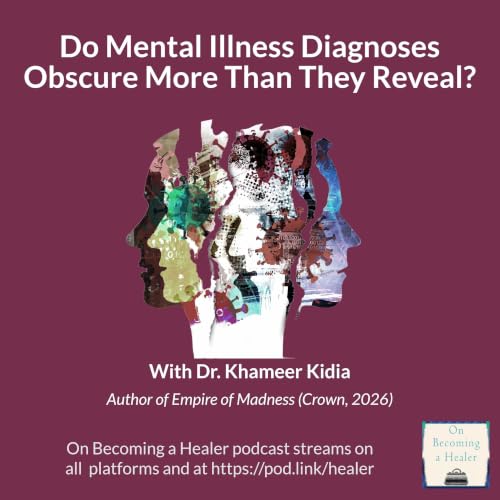
  • Do Mental Illness Diagnoses Obscure More Than They Reveal?
    2026/06/16

    What if many of the core assumptions of modern psychiatry are wrong?

    In this episode, we speak with internist and author Dr. Khameer Kidia about his provocative new book, Empire of Madness: Reimagining Western Mental Health Care for Everyone. Kidia argues that mental illnesses are often understood too narrowly through a biomedical lens and that psychiatric diagnoses may function less as explanations for suffering than as labels we apply to it. As he puts it, "generalized anxiety disorder doesn't cause anxiety; rather, anxiety causes generalized anxiety disorder."

    Drawing on experiences in both Zimbabwe and the United States, Kidia challenges us to reconsider how culture, inequality, migration, social isolation, debt, and political structures shape psychological distress. He discusses evidence that conditions such as schizophrenia present very differently across cultures and explores why outcomes in some lower-income countries may surpass those in wealthier nations despite far less reliance on psychiatric medications.

    Throughout the conversation, we return to a practical question: How should clinicians care for patients when the roots of suffering often lie beyond the reach of medicine itself? We explore how a deeper understanding of the social and political dimensions of mental health might change the questions physicians ask, the assumptions they bring to clinical encounters, and the ways they connect with patients.

    続きを読む 一部表示
    50 分
  • "Dire Consequences": When students do not receive appropriate accommodations on the USMLE examinations
    2026/05/19

    In last month's episode we learned that there is no evidence that time limits that impose any sort of pressure on even a small percentage of students improves test validity and that, in fact, there is ample research showing that they make tests less valid and less equitable.

    In this episode we discuss how, despite the data, the NBME denies accommodations on the USMLE exams to over half of medical students who have a documented learning disability and are approved for accommodations at their medical school (e.g., extra time).

    We talk with a leading medical educator who is co-author (along with last month's guest and co-host Saul Weiner), of a paper published last month in the journal Medical Education, titled The myth that slow test-takers are worse students: Implications for time-limited testing. The publication is Open Access, so fully accessible to everyone.

    In this episode, originally aired in 2023, our guest discusses a published national survey she and her colleagues conducted to assess the scope and harmful impact on medical schools and their students of current NBME policy on accommodations.

    We conclude with a discussion about how the NBME could make the test fair and valid for everyone by functionally eliminating time limits.

    続きを読む 一部表示
    46 分
adbl_web_anon_alc_button_suppression_t1
まだレビューはありません