エピソード

  • Contextualizing Care: From Competency to Curriculum (BONUS Episode)
    2026/06/30

    Over the past several years, contextualizing care has surfaced repeatedly on On Becoming a Healer. In 2025, contextualizing care was incorporated into new Foundational Competencies for Undergraduate Medical Education. Around the same time, co-host Saul Weiner worked with the Institute for Healthcare Improvement (IHI) to develop an online course designed to teach these skills, called Contextualizing Care for the Clinician (IHI Open School).

    Now that the course has been added to IHI's subscription-based Open School curriculum, making it available to learners at hundreds of subscribing institutions, we thought it would be a good time to revisit several conversations from past episodes that illustrate what contextualizing care is, why it matters, and how we can teach it.

    続きを読む 一部表示
    20 分
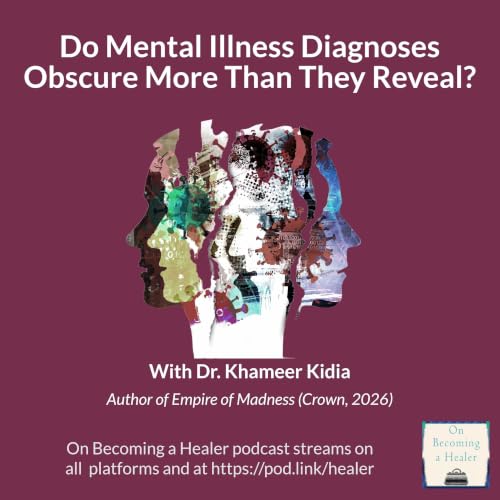
  • Do Mental Illness Diagnoses Obscure More Than They Reveal?
    2026/06/16

    What if many of the core assumptions of modern psychiatry are wrong?

    In this episode, we speak with internist and author Dr. Khameer Kidia about his provocative new book, Empire of Madness: Reimagining Western Mental Health Care for Everyone. Kidia argues that mental illnesses are often understood too narrowly through a biomedical lens and that psychiatric diagnoses may function less as explanations for suffering than as labels we apply to it. As he puts it, "generalized anxiety disorder doesn't cause anxiety; rather, anxiety causes generalized anxiety disorder."

    Drawing on experiences in both Zimbabwe and the United States, Kidia challenges us to reconsider how culture, inequality, migration, social isolation, debt, and political structures shape psychological distress. He discusses evidence that conditions such as schizophrenia present very differently across cultures and explores why outcomes in some lower-income countries may surpass those in wealthier nations despite far less reliance on psychiatric medications.

    Throughout the conversation, we return to a practical question: How should clinicians care for patients when the roots of suffering often lie beyond the reach of medicine itself? We explore how a deeper understanding of the social and political dimensions of mental health might change the questions physicians ask, the assumptions they bring to clinical encounters, and the ways they connect with patients.

    続きを読む 一部表示
    50 分
  • "Dire Consequences": When students do not receive appropriate accommodations on the USMLE examinations
    2026/05/19

    In last month's episode we learned that there is no evidence that time limits that impose any sort of pressure on even a small percentage of students improves test validity and that, in fact, there is ample research showing that they make tests less valid and less equitable.

    In this episode we discuss how, despite the data, the NBME denies accommodations on the USMLE exams to over half of medical students who have a documented learning disability and are approved for accommodations at their medical school (e.g., extra time).

    We talk with a leading medical educator who is co-author (along with last month's guest and co-host Saul Weiner), of a paper published last month in the journal Medical Education, titled The myth that slow test-takers are worse students: Implications for time-limited testing. The publication is Open Access, so fully accessible to everyone.

    In this episode, originally aired in 2023, our guest discusses a published national survey she and her colleagues conducted to assess the scope and harmful impact on medical schools and their students of current NBME policy on accommodations.

    We conclude with a discussion about how the NBME could make the test fair and valid for everyone by functionally eliminating time limits.

    続きを読む 一部表示
    46 分
  • Why it's time to remove time limits on tests, like the USMLE exam
    2026/04/21

    There is a widely held misperception that being able to complete a test quickly is an indication of mastery when compared with those who need more time. As a result, it is often difficult to obtain accommodations on high stakes examinations, including the MCAT and USMLE exams. Many students who request extra time because of a disability are denied accommodations and many other students who need it aren't eligible (e.g., English is a second language) or are inhibited from applying (e.g., Veterans, students from certain cultural backgrounds).

    In this month's issue of the journal Medical Education, titled The myth that slow test-takers are worse students: Implications for time-limited testing (open access), the authors review the evidence that time pressuring even a small proportion of students taking an exam makes it less valid and less equitable, and that a simple solution would be to give everyone the time they need. In this episode, originally aired in 2023, we hear from one of the authors about why it's past time to do away with time limited tests for everyone.

    続きを読む 一部表示
    44 分
  • Why Good Primary Care Is Non-Negotiable
    2026/03/17

    In a recent five-part series in the New England Journal of Medicine on the future of primary care, the author asks:

    "Has the long-term general doctor become obsolete? In other words, should the dying primary care system be saved?"

    The question itself is unsettling. Could a health system function effectively without primary care? What happens to patients when no one is responsible for truly caring about them and guiding them safely through the health care system? Today many, perhaps most, Americans don't have a doctor like that. But is that okay?

    Research by one of the hosts, based on thousands of recorded physician–patient encounters, suggests that physicians who consider the circumstances, needs, and priorities of each patient when planning their care are uncommon.

    In this episode, we introduce you to a primary care physician with his own practice in a mid-size Western city who, like many others — but far too few — provides this indispensable service to his community. He is a skilled and deeply knowledgeable clinician, a caring advocate who knows his patients well and finds the work deeply rewarding, despite the daily frustrations of insurance denials, specialists who don't return calls, and a payment system that measures almost everything except how well physicians care for people when they are sick.

    There is also a major medical education challenge. What is poorly understood is that producing an excellent primary care physician is often harder than producing an excellent specialist. The work depends less on mastering technical procedures and more on integrating complex information, building long-term relationships, and making collaborative decisions under conditions of uncertainty.

    Far too few graduates of U.S. medical schools and residency programs are being prepared for — or supported in — this kind of work. In a profit-driven health system that can at times be predatory, where patients are exposed to unnecessary procedures while their mental health and well-being are overlooked, the absence of accessible, high-quality primary care leaves patients vulnerable and often very alone.

    続きを読む 一部表示
    45 分
  • Preventing Suicide: How can we do better?
    2026/02/17

    Forty-five percent of patients who die by suicide saw a primary care physician in the prior month. Physicians screen for suicide risk just half the time when seeing patients under treatment of depression. Meanwhile, suicide rates continue to rise in the United States and are the second leading cause of death among young people. In this episode, Saul interviews co-host Stefan, who is leading a national study of suicide in patients on chronic opioids who take their own lives after their physician tapered or cut off their opioids without their consent. They discuss the rich literature, theoretical and empirical, on why people take their lives, what stops them, and what a caring health professional can do to make a difference.

    Please note: if you are in crisis, US-based crisis supports are available by calling 988, and at https://988lifeline.org. An international listing of hotlines is offered at https://blog.opencounseling.com/suicide-hotlines/.

    続きを読む 一部表示
    39 分
  • Bad Leadership in Academic Medicine and Health Care: Let's Talk about It
    2026/01/20

    Unfortunately, bad leadership is common, with 50% of American's leaving a job because of a bad boss, and medicine is no exception. Saul and Stefan, with a combined 60 years in academic medicine and clinical practice, share personal experiences and anecdotes that highlight the characteristics of dysfunctional and toxic leaders, and discuss their implications for health care training and practice environment, including the trickledown effect on patients. They consider why and how bad leaders end up in positions of power, and what to do about it, acknowledging the difficulties in identifying and promoting effective leaders.

    続きを読む 一部表示
    54 分
  • Poems about the wretched illness experience when your doctor is"clinically detached"
    2025/12/16

    Writing about the illness experience, medical sociologist Richard Frank described an unspoken agreement with his doctor that if he adopted their detached and clinical language when discussing his illness, "I would have at least a junior place on the management team." Initially it seemed like "not a bad deal," until he experienced the toll it took, concluding that, "No one should have to stay cool and professional while being told their body is breaking down, though medical patients always have to do just that."

    Through three poems selected by our repeat guest, English professor Laura Greene of Augustana College, we see the pain and cost to patients when their doctors and nurses hold them at arm's length, unable or unwilling to see their humanity. We reflect on why, and what to do about it.

    続きを読む 一部表示
    50 分