• Building a Career Without Pretending to Be Someone Else | Jason Clark
    2026/07/14
    In this episode of Unconventional Wisdom About Conventional Wisdom, Kim Miller-Hershon sits down with Jason Clark creative leader and marketing strategist with a career spanning more than three decades. Since 1990, Jason has worked at the intersection of design, technology, and storytelling, helping organizations translate complex ideas into clear, compelling brands. He bought into a small ad agency in 2003, bought out his partner, grew the business to 18 employees, and in 2023 almost exactly 20 years later sold and merged it into a larger digital services firm now known as Tectonic, where he serves as chief marketing officer. He's also spent 30-plus years throwing dance music parties, and opens the conversation with a genuinely uncanny story about hunting a rare set of books for years and walking into a Chicago bookstore fifteen minutes after someone sold them across the counter. In this conversation, Jason challenges the piece of conventional wisdom most professionals absorb without question: that you should keep who you really are separate from who you are at work. Early in his career he assumed he'd have to hide the tattoos, sand down the weirdness, keep the LinkedIn profile safely bland. Then his business partner said something that rearranged his thinking if someone won't do business with us because of your tattoos, I don't want to do business with them. The reframe wasn't "be weird and you'll succeed." It was that people want to work with people who are actually interesting, and the real task is finding a way to connect your values to your work rather than performing a version of yourself you can't sustain. Jason and Kim also dig into the myth of the one-size-fits-all playbook. He can trace the line from high schooler to near-retirement at 55, but only backward he had no idea what he was doing moving forward, and the path that got him here won't get anyone else there. If a single program really worked every time, they agree, we'd all be billionaires and they'd teach it in grade school. They talk about mining unlikely life experience for real transferable skill (his rave promotion taught him P&Ls; Kim's volunteer work taught her operations), about the difficult transition from business to enterprise, and about the founders who stay in everyone's way until the stress becomes a health issue. And on imposter syndrome, Jason offers the cleanest antidote in the episode: self-awareness beats omniscience. "I don't know" is a complete sentence. "I'll find out for you" is another. This episode explores: Why keeping your real self out of your work eventually breaks youThe tattoo conversation that changed how Jason ran his businessFinding a way to align your values with your career without "finding your passion"Why there's no one-size-fits-all path, and every playbook is someone else'sMining unconventional life experience for transferable skillsMaking the shift from technical skill to leadership skill IQ to EQKnowing when you need a coach (and when you just need to get out of your own way)Why so much flowing through the founder stunts the whole teamThe hard transition from business to enterpriseBuilding something that outlasts you, then letting it go Jason's perspective is a powerful reminder that success rarely follows the map you were handed and that the parts of yourself you were told to hide are often the parts that make the work worth doing. His arc from a kid with no money to an agency owner to a CMO shows that money buys choices, but a life spent performing someone else's version of professionalism buys misery. If you're a business owner, creative, or leader stuck in your own way, this conversation offers practical insight, honest talk about growth and self-awareness, and a refreshing case that the most interesting person in the room is usually the one asking the questions. Connect with me here: Website: https://www.kimmillerhershon.comLinkedIn: https://www.linkedin.com/in/kmillerhershonNewsletter: https://link.kimmillerhershon.com/widget/form/aEdmdA1W5MhoMCMfy5O8Webinar: https://webinar.kimmillerhershon.com/?utm_source=Podcast Guest Details: Guest: Jason ClarkCompany: Tectonic — Chief Marketing OfficerFocus: Design, technology, and brand storytelling Hosted by Simplecast, an AdsWizz company. See pcm.adswizz.com for information about our collection and use of personal data for advertising.
    続きを読む 一部表示
    40 分
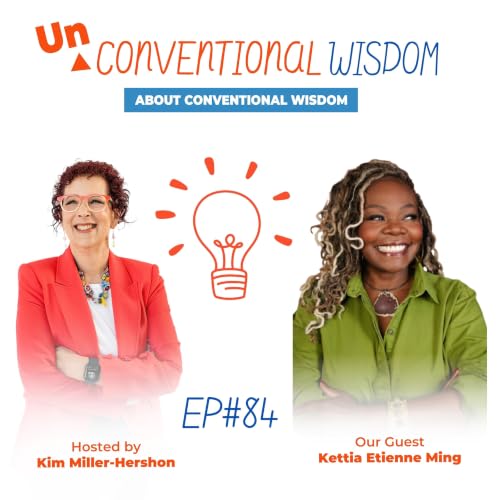
  • Business Exit, a Fortune 500 Lawsuit, and Building Resilience Through Hard Times | Kettia Ming
    2026/07/10
    In this episode of Unconventional Wisdom About Conventional Wisdom, Kim Miller-Hershon sits down with Kettia Ming entrepreneur, author, business strategist, and nonprofit executive whose work explores resilience, reinvention, and the realities of building a meaningful life and business. Kettia founded and scaled a childcare company in New York City before selling it in a multimillion-dollar acquisition, and now serves as executive director of Black Theatre United, where she leads programs and partnerships designed to expand access and opportunity across the Broadway industry. She's also the founder of The Childcare Collective and Evergreen House Press, and the author of Run the Mile You're In: One Founder's Journey Through Success, Loss & Reinvention. A lifelong runner who has completed 13 marathons, including Boston, she brings the lessons of endurance, identity, and starting again into everything she does and the medals on her wall are less about the finish line than the journey it took to get there. In this conversation, Kettia challenges one of the most reflexive beliefs in business: that success always means growth. Early on, she assumed a successful business meant more locations, more revenue, more employees just more, because that's what the internet tells you. But growth brings complexity, and in a business built on leases and the licensed care of small humans, more can quietly become unsustainable. The better questions, she found, weren't about scale at all: What am I building? Why? And what will it require of me to sustain it? A turning point in Kettia's story arrived the day after the Boston Marathon, on the Amtrak home, when she finally opened a string of emails she'd been ignoring. A Fortune 500 buyer claimed her new center violated a non-compete by 100 feet. She had measured the distance carefully, the way you walk, drive, and run it; they measured it "as the crow flies," a term she'd never encountered, calculated by a surveyor she didn't know existed. With her family's future, home, and the proceeds of her sale all sunk into the new startup, she moved through denial, anger, and fear — then did the opposite of panic. She went completely still, went inward, and focused on one question: how do I get through this in one piece, with my family intact? The episode closes on the tools that keep her steady: walking away from a problem to let the solution surface (wisdom from her late father, who believed every problem already contains its answer if you get quiet enough), and treating imposter syndrome the way she treats the voice of doubt — acknowledge it, refuse to fight it, and don't give it a vote. This episode explores: Why "always grow" is the wrong default — and the better questions to askBuilding for sustainability instead of scale for its own sakeHow owners become employees of their own business — and how to stopMoving forward before you feel confident, because the answers come as you moveThe 100-feet "as the crow flies" lawsuit and what she couldn't have knownLetting go of "I should have known" when you did everything rightGoing still under pressure instead of spinning outThrowing out the belief that a leader must have all the answersWhy psychological safety has to start at the topLeading a multigenerational, multicultural team with a real sense of belongingWalking away from a problem to let the solution find youAsking your subconscious the question before you sleepWorking with imposter syndrome instead of against it Kettia's perspective is a powerful reminder that resilience isn't loud sometimes it's the stillness you find when everything's in jeopardy, and the refusal to beat yourself up for what you couldn't have known. Her journey from a basement childcare startup to a Fortune 500 legal fight to a thriving nonprofit shows that you don't have to run all 26 miles at once. You just have to run the mile you're in. If you're an entrepreneur, nonprofit leader, or anyone facing something hard right now, this conversation offers practical wisdom, hard-won honesty about doubt and imposter syndrome, and a refreshing case that surviving the worst can leave you stronger than before. Connect with me here: Website: https://www.kimmillerhershon.comLinkedIn: https://www.linkedin.com/in/kmillerhershonNewsletter: https://link.kimmillerhershon.com/widget/form/aEdmdA1W5MhoMCMfy5O8Webinar: https://webinar.kimmillerhershon.com/?utm_source=Podcast Guest Details: Guest: Kettia Ming entrepreneur, author, business strategist, and executive director of Black Theatre United; founder of The Childcare Collective and Evergreen House PressBook: Run the Mile You're In: One Founder's Journey Through Success, Loss & ReinventionWebsite: https://www.kettiaming.com Find Kettia online: Website: https://www.kettiaming.comNewsletter — Run the Mile You're In on SubstackInstagram: https://www.instagram.com/kettia/LinkedIn: https://www.linkedin.com/in/kettiamingSpeaking, podcast, and partnership inquiries: mingkettia...
    続きを読む 一部表示
    38 分
  • Building a Team That Doesn't Need You: Resourcefulness, Focus, and the "I Belong" Mindset | Christian Espinosa
    2026/07/07

    In this episode of Unconventional Wisdom About Conventional Wisdom, Kim Miller-Hershon sits down with Christian Espinosa best-selling author, cybersecurity entrepreneur, and 24-time Ironman triathlete who built and sold Alpine Security and now leads Blue Goat Cyber, securing medical devices for FDA compliance. A blood clot survivor, Christian shares practical strategies for overcoming adversity, building resilient leadership, and navigating cybersecurity challenges. His books, The Smartest Person in the Room and The In-Between, explore how mindset shifts and emotional intelligence drive success. He's also, it turns out, a qualified Formula Four driver and the conversation opens on the track, where he's learned that slow is smooth, smooth is fast, and brute force only runs you off the road.

    In this conversation, Christian challenges a piece of conventional wisdom he swallowed whole with his first company: that everybody needs what you sell, so you should sell to everybody. Trying to push fifteen cybersecurity services to every vertical at once, he diluted his brand, diluted his messaging, and landed nowhere. The fix was counterintuitive — say no to fourteen things and go all in on one. At Blue Goat Cyber, doing one thing extremely well brings in far more revenue than chasing everything did. Niche down, know your ideal client, solve one real pain point.

    Christian and Kim also dig into a leadership habit that separates founders who scale from founders who don't: refusing to be the answer to everything. When his team asks him something he could easily answer, he often points them to the resources instead, because handing over the answer every time keeps people dependent and keeps him the constraint. As Kim frames it, a leader who supplies every answer becomes a slave to the business, unable to unplug, unable to step away, unable to grow the thing past themselves. A successful business, Christian insists, shouldn't need him at all.

    The two also explore the stories we tell ourselves — the theme of Christian's next book. They trade notes on the power of "I am" statements as identity, the smoker who quits versus the non-smoker who simply is one, and the danger of ignoring the gut voice that already knows. They talk about tuning in rather than tuning out, choosing yourself over reliving old trauma, and doing the inner work so you stop recreating the same circumstance. And when the talk turns to imposter syndrome, Christian offers the most concrete fix of the episode: a bracelet engraved "I belong," worn and read every day until the room he doubted became the room he owned. Change the story, and the conversations change with it.

    This episode explores:

    • Why "everybody needs it" is a trap — and how niching down grows revenue
    • Unlearning the craving for security to step into entrepreneurship
    • Teaching your team to be resourceful instead of dependent
    • Why a leader who answers everything becomes a slave to the business
    • Tuning in to the gut voice instead of rationalizing it away
    • Choosing yourself over reliving old trauma
    • The stories we tell ourselves, and the power of "I am" statements
    • Interrogating a big reaction before responding to the trigger
    • Doing the inner work so you stop recreating the same situation

    If you're an entrepreneur, leader, or anyone wrestling with the gap between what you know and what you do, this conversation offers practical insight, honest talk about imposter syndrome, and a refreshing case that the story you tell yourself is the one thing you always get to rewrite.

    Connect with me here:

    • Website: https://www.kimmillerhershon.com
    • LinkedIn: https://www.linkedin.com/in/kmillerhershon
    • Newsletter: https://link.kimmillerhershon.com/widget/form/aEdmdA1W5MhoMCMfy5O8
    • Webinar: https://webinar.kimmillerhershon.com/?utm_source=Podcast

    Guest Details:

    • Guest: Christian Espinosa
    • Company: Blue Goat Cyber
    • Books: The Smartest Person in the Room and The In-Between (with a new book on the stories we tell ourselves expected early next year)

    Hosted by Simplecast, an AdsWizz company. See pcm.adswizz.com for information about our collection and use of personal data for advertising.

    続きを読む 一部表示
    40 分
  • The Success "Formula" Nobody Warns You About: Why One-Size-Fits-All Advice Fails | John Cousins
    2026/07/03

    In this episode of Unconventional Wisdom About Conventional Wisdom, Kim Miller-Hershon sits down with John Cousins investor, tech founder, and best-selling author of Corporate Finance ASAP and, remarkably, over 60 other books. John is the founder of MBA ASAP, which has trained more than 30,000 students across 165 countries, along with corporations like Adidas, Apple, General Mills, Kaiser Permanente, Lyft, PayPal, Pinterest, Mercedes-Benz, and Volkswagen. He's also taught MBA students at universities around the world. Outside of business, he's a lifelong jazz pianist — and the conversation opens with a rich detour into how jazz, for all its improvisation, is built on tight, shared structure.

    In this conversation, John challenges one of the deepest lessons school drills into us: that success means never failing. As an engineer turned entrepreneur, he had to unlearn the test-taking mindset entirely.

    A turning point in John's story is his slow, deliberate walk away from corporate life. He started as an electrical engineer, studied at MIT, and spent the 1980s at ABC producing Wide World of Sports, World News Tonight, Olympics, and space shuttle launches — a dream job for a guy in his 20s. But he chafed under being told what to do, so he left, got his MBA, and hasn't had a boss since 1988. Over the following decades he shed the parts of business that constrained him — investors, partners, employees, big customers — until he built something he could run solo. Digital downloads and the internet let him reach a global "long tail" of students with no working capital and no accounts receivable. As he puts it, it's a wonderful time to be alive.

    John and Kim also dig into the gap between what we know and what we actually do — Kim's real fascination as a coach. They explore DISC as a tool for communication and negotiation,And when the talk turns to imposter syndrome, John flips it on its head. Rather than talking himself out of it with credentials, he treats it as a signal of the Dunning-Kruger effect in reverse — proof you know enough to know you don't know everything. His grounded answer to any gap: "I don't know, and I'll find out." Strong convictions, loosely held.

    This episode explores:
    * Why school's "never fail" lesson is the wrong mindset for building anything
    * Failing fast and forward as the real engine of entrepreneurship
    * How jazz's structure mirrors the constraints inside creative work
    * John's decades-long move away from bosses, partners, and investors
    * Building a global, solo business on digital downloads and no working capital
    * DISC as a tool for better communication and negotiation
    * Why revenue growth can be a vanity metric — and simplicity scales
    * Reframing imposter syndrome through Dunning-Kruger and Socratic humility

    John's perspective is a powerful reminder that there's no single recipe for success — only the willingness to fail, adapt, and stay honest about what you don't know. His arc from MIT engineer to boss-free global educator shows that you can build a business shaped entirely around who you actually are, if you're patient enough to let the path reveal itself.

    If you're an entrepreneur, creative, lifelong learner, or anyone tired of the "shoulds" that pass for business advice, this conversation offers practical insight, candid honesty about imposter syndrome, and a refreshing case that the smartest thing you can say is often "I don't know — let me find out."

    Connect with me here:
    * Website: https://www.kimmillerhershon.com
    * LinkedIn: https://www.linkedin.com/in/kmillerhershon
    * Newsletter: https://link.kimmillerhershon.com/widget/form/aEdmdA1W5MhoMCMfy5O8
    * Webinar: https://webinar.kimmillerhershon.com/?utm_source=Podcast

    Guest Details:
    * Guest: John Cousins
    * Company: MBA ASAP
    * Books: Corporate Finance ASAP and 60+ others (including titles on Miles Davis, the Great American Songbook, and focus


    Hosted by Simplecast, an AdsWizz company. See pcm.adswizz.com for information about our collection and use of personal data for advertising.

    続きを読む 一部表示
    44 分
  • Building and Handing Off a Law Practice: Succession, Books as Business Cards, and Imposter Syndrome | Garrett & Ted Sutton
    2026/06/30
    In this episode of Unconventional Wisdom About Conventional Wisdom, Kim Miller-Hershon does something a little different — instead of one guest, she sits down with two: Garrett Sutton and his son, Ted Sutton. Garrett is the founder of Corporate Direct and Sutton Law, an award-winning author of 11 books whose titles have sold over a million copies (including Start Your Own Corporation and Loopholes of Real Estate), an asset protection attorney, and for 25 years the legal architect of business protection in Robert Kiyosaki's Rich Dad world. For 35+ years, his firm Corporate Direct has helped entrepreneurs, real estate investors, and digital asset investors protect their personal assets in all 50 states — and more recently he founded Tenero.TV and Tenero Productions to make meaningful film. Ted is a partner and asset protection attorney at Corporate Direct, specializing in business formation and the maintenance of corporations and LLCs, and he even helped spearhead work around the new Corporate Transparency Act. The father-son pair share a passion for skiing — Garrett raised Ted on the slopes near their home in Reno, Nevada, at age two, and Ted went on to ski competitively, winning a Nevada state championship in high school. In this conversation, the Suttons challenge a piece of conventional wisdom baked into the legal profession itself: the billable hour. Early in his career, Garrett bristled at the pressure to bill for every minute. When he built his own practice and connected with Robert Kiyosaki, he moved to a flat-fee model — clients know exactly what they'll pay up front, with no anxious guessing about whether a call costs them five minutes or twenty. It's a model that removes friction for the client and, as Kim notes, still rewards Garrett for being efficient with his time. A turning point in the family story is Ted's path to the firm. Garrett and Ted's mother — a doctor — deliberately put no pressure on their kids to follow a professional track. Ted studied mining engineering at the University of Utah, even spending three months at a mine in Chile's Atacama Desert before realizing the remote life wasn't for him. He came to law on his own, drawn not by courtroom glory but by the chance to take over the family business and help the people his father had spent decades serving. It's the quiet engine of the whole episode: a peaceful succession, where Garrett phases out as Ted phases in, mentor and successor side by side. The two also explore the abundance mindset Ted absorbed from his father's world, the constant challenge of finding people with real work ethic, and Garrett's refusal to sell to private equity firms that would squeeze the clients he's served for 20 years. And both have books to show for it — Garrett's eight titles in Kiyosaki's series, plus his newest project, the Sports Heaven: The Birth of ESPN audiobook and documentary about ESPN's founder, available to rent exclusively on Tenero.TV. Ted's debut, Greenback's Book of Law, teaches law basics to parents, kids, and young adults through the eyes of Greenback — a friendly goldendoodle whose owner is Ernie the Attorney — filling the same gap that financial literacy education leaves in schools, with a companion card game on the way. This episode explores: Why the billable hour didn't fit — and how a flat-fee model serves clients betterLetting kids find their own path instead of pushing them toward a professionTed's pivot from mining engineering in the Atacama Desert to lawWhat a peaceful family-business succession actually looks likeWhy you'll never do just "one thing" as a lawyer — and how you learn on the jobThe freedom of saying "I'm not your person" and referring work outThe Toxic Client lesson: 80% of problems come from 20% of clientsAvoiding some mistakes through a mentor — and why some you have to learn by fire The Suttons' perspective is a powerful reminder that success can be built on your own terms — flat fees instead of billable hours, your own path instead of an inherited one, and clients you actually want to serve instead of a quick payday. Their story of a father and son building something durable together shows that the most valuable thing you can pass down isn't a business, but the wisdom of how to run it well. If you're an entrepreneur, professional, family-business owner, or anyone navigating succession, this conversation offers practical insight, candid talk about imposter syndrome, and a refreshing case that doing right by your clients and your people is its own kind of strategy. Connect with me here: Website: https://www.kimmillerhershon.comLinkedIn: https://www.linkedin.com/in/kmillerhershonNewsletter: https://link.kimmillerhershon.com/widget/form/aEdmdA1W5MhoMCMfy5O8Webinar: https://webinar.kimmillerhershon.com/?utm_source=Podcast Guest Details: Guests: Garrett Sutton (Founder/CEO, Corporate Direct; TENERO Host/Founder; Rich Dad Advisor) & Ted Sutton (Partner & Asset Protection Attorney, ...
    続きを読む 一部表示
    30 分
  • Career Pivots, Lifelong Learning, and Building a Business After an AI Layoff with Ryan Drumheller
    2026/06/26
    In this episode of Unconventional Wisdom About Conventional Wisdom, Kim Miller-Hershon sits down with Ryan Drumheller a self-described extroverted IT leader, fractional CIO, and founder of StellarHorn Group, where he helps businesses cut through the noise of technology and AI to drive real, measurable results. With over 20 years of experience in IT and leadership, Ryan is a relentless lifelong learner: two master's degrees, a bachelor's, more than 170 certifications, and doctoral ambitions still on the table. Outside of work, he's into music, sports, and video games and lately, golf. Ryan's path to all those credentials was anything but linear. He flamed out of community college after a year, landed an IT job quickly, and spent his twenties working hard without much of a plan. His parents young, with his dad a corrections officer steered him toward trade school, but Ryan was already taking apart PCs at night and quietly betting that IT was the future. The career epiphany didn't hit until his late twenties, when he looked at the hours he was putting in and thought, it can be different. That's when he went back for his bachelor's, then his master's, and never really stopped. In this conversation, Ryan challenges one of the most rigid beliefs in our culture: that there's one right path high school, straight to college, straight to career and that falling outside it means you won't amount to much. He's living proof otherwise. He and Kim get into how traditional education rewards a single narrow kind of intelligence, and how much talent gets boxed out because it doesn't fit. Ryan aced the technical classes he cared about even student-taught a programming course in high school while checking out of everything else. His bachelor's forced him through courses he found irrelevant; his master's, at a school built around relevant coursework, was night and day. Proof, as Kim puts it, that it can be done differently if we're open to it. Ryan and Kim also dig into the hard, honest math of going out on your own. Faced with a likely steady paycheck versus chasing the dream, Ryan landed on doing both taking the guarantee while building the product in the shadows. Along the way he learned something important about himself: he sells a product he believes in with total confidence, but selling himself as a service always felt like a stumble. The deeper realization is that he works better with people than as a solopreneur and instead of fighting his own nature, he's building something that fits it. Underneath it all, he's candid that imposter syndrome shows up in every phase, and that his answer is the same each time: look at the evidence, and remember that he's always figured it out before. This episode explores: Why the linear path — high school, college, career — isn't the only route to successHow a community-college flameout became a 170-certification careerWhy traditional education rewards one narrow kind of intelligenceUsing what you're good at to help you learn what's hardThe career epiphany: realizing "it can be different"Turning a job loss in the AI wave into a deliberate pivotHow a hobby meant to escape technology became the work itselfThe honest math of a steady paycheck vs. chasing the dream — and doing bothWhy if you can't sell, you don't have a businessBuilding around your nature instead of fighting it (team player vs. solopreneur)Using AI as a creative thought partner, not a human replacementWhy imposter syndrome shows up at every stage — and how evidence pulls you out"You're not a victim, you're a survivor": owning your experience and doing the work Ryan's perspective is a powerful reminder that there's no single timeline for figuring it out — and that the disruptions we don't choose can point us toward the work we're actually built for. His journey from a checked-out high schooler to a credential-stacking CIO building a company around the game he loves shows that you can take the unconventional route and still arrive somewhere that feels like home. If you're a leader, technologist, career-changer, or anyone who took the long way around, this conversation offers practical perspective, hard-won honesty, and a refreshing case that you can pick yourself up, pivot, and keep moving — no cheat codes required. Connect with me here: Website: https://www.kimmillerhershon.comLinkedIn: https://www.linkedin.com/in/kmillerhershonNewsletter: https://link.kimmillerhershon.com/widget/form/aEdmdA1W5MhoMCMfy5O8Webinar: https://webinar.kimmillerhershon.com/?utm_source=Podcast Guest Details: Guest: Ryan DrumhellerCompany: StellarHorn GroupFocus: Fractional CIO services; building golf technology software Hosted by Simplecast, an AdsWizz company. See pcm.adswizz.com for information about our collection and use of personal data for advertising.
    続きを読む 一部表示
    44 分
  • From Abandoned at 11 to Trusted Advisor to Millionaires: Victoria Woods' Story
    2026/06/23
    In this episode of Unconventional Wisdom About Conventional Wisdom, Kim Miller-Hershon sits down with Victoria Woods wealth advisor, trusted advisor to millionaires, and founder and CEO of Chapelwood Financial Services, where she specializes in high-net-worth investment advisory. Victoria has been featured in Newsweek, named one of 100 Women to Know in America in 2023, and is the author of It's All About the Money, Honey. Victoria's story doesn't begin with wealth. It begins with a father who abandoned the family when she was eleven, a stay-at-home mom suddenly raising four kids on $96-a-month rent, and a childhood spent cooking for her siblings on a hot plate. She started babysitting at twelve and quickly went from minding one child to running six at a time. She built a celebrated retail career, walked away from the corporate world at twenty-three, and eventually built three companies over three decades. In this conversation, Victoria challenges one of the most paralyzing beliefs in business: the idea that you have to have all the answers before you're allowed to lead. Early on, she pretended she had it all figured out confident on the outside, "sweat running down my back" on the inside. What she learned was that nobody expects you to know everything, and admitting you don't isn't weakness. The real skill is being clear about who you are and where you're going, then having the nerve to ask for help getting there. A turning point came the night she asked her store manager for a raise she had earned top sales, most departments and was told the money was going to "Lazy Bill" in furniture instead, because Bill was married with children and she was single. By the next morning she was clear: she would never again let someone else decide her worth. It's the moment that crystallized the phrase she still lives by in the absence of courage, do it scared. Much of the episode is a masterclass in asking for what you want. Victoria describes the goal card she created in her fifties her photo, a QR code, and a handful of specific annual goals which she hands to powerful people across the table, then sits back in silence and lets them volunteer how they can help. She writes their names down, names the commitment out loud, and follows up. Even her own business coach was left speechless watching it work. Victoria and Kim also dig into generosity as a discipline rather than a reward "give while you're living" and the lesson that what you give out rarely returns from the direction you sent it, but always returns. They talk about the loneliness of building something that eventually doesn't need you, which is exactly the point: if the company depends on the founder, Victoria says flatly, you don't have a business, you have a hobby. And underneath it all, she's candid that imposter syndrome never fully leaves her answer is the same as always: keep serving, keep moving, and don't take advice from broke people. This episode explores: Why you don't need all the answers to start — and why pretending you do holds you backHow a childhood of scarcity became an entrepreneurial educationThe raise that wasn't, and the "fork in the road" moment that changed everything"In the absence of courage, do it scared" as a working philosophyThe goal-card method for asking powerful people for help — and why silence is the secretWhy asking for advice is a strength, not a weaknessGiving while you're living, and treating generosity as a responsibilityThat you don't have to be rich to help: a dollar's a dollarWhy a business that depends on its founder isn't really a businessThe bittersweet goal of training your team so well that clients stop needing youWhy imposter syndrome can persist at every level of successSpeaking to clients in plain English instead of jargon"Don't take advice from broke people" — and how to vet credibility before you listen Victoria's perspective is a powerful reminder that success isn't about arriving with all the answers it's about clarity, courage, and a willingness to keep serving even when you're scared. Her journey from a broken stove and floated checks to one of the most respected women-owned advisory firms in the country shows that you can build real wealth without losing your warmth. If you're an entrepreneur, advisor, leader, or anyone who's ever felt like they don't quite belong in the room, this conversation offers practical tools, hard-won wisdom, and a refreshing case that the bravest thing you can do is ask for what you want and then do the work. Connect with me here: Website: https://www.kimmillerhershon.comLinkedIn: https://www.linkedin.com/in/kmillerhershonNewsletter: https://link.kimmillerhershon.com/widget/form/aEdmdA1W5MhoMCMfy5O8Webinar: https://webinar.kimmillerhershon.com/?utm_source=Podcast Guest Details: Guest: Victoria WoodsCompany: Chapelwood Financial ServicesBook: It's All About the Money, Honey (also available as an audiobook) Website: FinancialDiva.com Hosted by Simplecast, an AdsWizz ...
    続きを読む 一部表示
    48 分
  • From Special Ops to $70M in Real Estate: Leadership, Letting Go, and Profits With Purpose with Jesse Sells
    2026/06/19
    In this episode of Unconventional Wisdom About Conventional Wisdom, Kim Miller-Hershon sits down with Jesse Sells co-founder and chief operating officer of Impact Growth Capital, where he runs the daily operations of a diverse portfolio of properties and companies. With a strong passion for creating meaningful change, Jesse connects strategic vision with concrete results, making sure each project not only hits its goals but lifts up the community and the wider market along the way. Jesse's path was anything but conventional. He grew up poor in rural Oklahoma at times without running water before moving to Texas and joining the military, where he spent his twenties in military intelligence and was picked up by Special Operations. His work in foreign internal defense took him across the Middle East, where he learned Arabic and learned, over countless glasses of tea, how trust actually gets built. After leaving the service, he and his brother pooled roughly $20,000 in life savings and, within a few years, built a portfolio of nearly 1,500 units focused on affordable and workforce housing partnering with nonprofits to bring mental health and community services to the people living in them. In this conversation, Jesse challenges one of the most stubborn beliefs in business: the idea that you have to choose between making money and doing good. Raised to resent wealth — he admits that as a kid he saw a new truck and thought "showoffs" he carried the common stigma that profit and purpose can't share a room. Over time, he came to see that as flat-out wrong. The more he earned, the more he could change: pay for nieces and nephews, fund services, and get a seat at the tables where real decisions get made. As he and Kim put it, you can't shift policy from the outside; you have to be in the room. Jesse and Kim also dig into the limits of conventional success advice — especially the "millionaire in 60 days" promise and the social-media fantasy that one viral moment equals a career. Both push back hard. Real success, Jesse argues, is more available than ever but never overnight, and a candle that burns that bright tends to burn out fast. Much of the episode turns on leadership and the hardest lesson of scaling: letting go. Drawing on the military's clarity about "left and right limits," Jesse explains how he set clear boundaries and then trusted his people to make decisions inside them supporting each one the way they needed, not the way he preferred. Kim adds the piece she sees leaders miss most: it's not just about deciding which decisions belong to whom, it's about the *feelings and identity* wrapped up in handing them over. When a founder's whole sense of self is "I'm the decision-maker," they'll claw the work back no matter how good the system is. Throughout the conversation, Jesse is candid about imposter syndrome, the messiness of "building the plane while flying it," and the quiet discipline behind his growth daily study, daily meditation, and a relentless focus on the 80/20 of what actually moves the needle. His trick for staying grounded in any room, even across from a billionaire: find the human first. This episode explores: * Why the "money vs. meaning" trade-off is a false choice * How profits and purpose can reinforce each other rather than compete * Why real impact requires a seat at the table, not just good intentions * The Fort Worth bus-stop story and what creativity-plus-legwork really looks like * Why "overnight success" and viral fame are traps, not strategies * What the military teaches about leadership that the civilian world often doesn't * Why your calendar, not your intentions, reveals your real priorities * How to beat imposter syndrome by finding the human in the room * Why cultural awareness changes how you lead, sell, and connect If you're an entrepreneur, investor, leader, or business owner trying to grow something that matters without losing yourself in the process, this conversation offers practical insight, hard-won leadership lessons, and a refreshing case that doing well and doing good were never meant to be separate. Connect with me here: * Website: https://www.kimmillerhershon.com * LinkedIn: https://www.linkedin.com/in/kmillerhershon * Newsletter: https://link.kimmillerhershon.com/widget/form/aEdmdA1W5MhoMCMfy5O8 * Webinar: https://webinar.kimmillerhershon.com/?utm_source=Podcast Guest Details: * Guest: Jesse Sells * Company: Impact Growth Capital * Focus: Affordable housing, infrastructure, and AI * LinkedIn: https://www.linkedin.com/in/jesse-sells/ Hosted by Simplecast, an AdsWizz company. See pcm.adswizz.com for information about our collection and use of personal data for advertising.
    続きを読む 一部表示
    35 分